

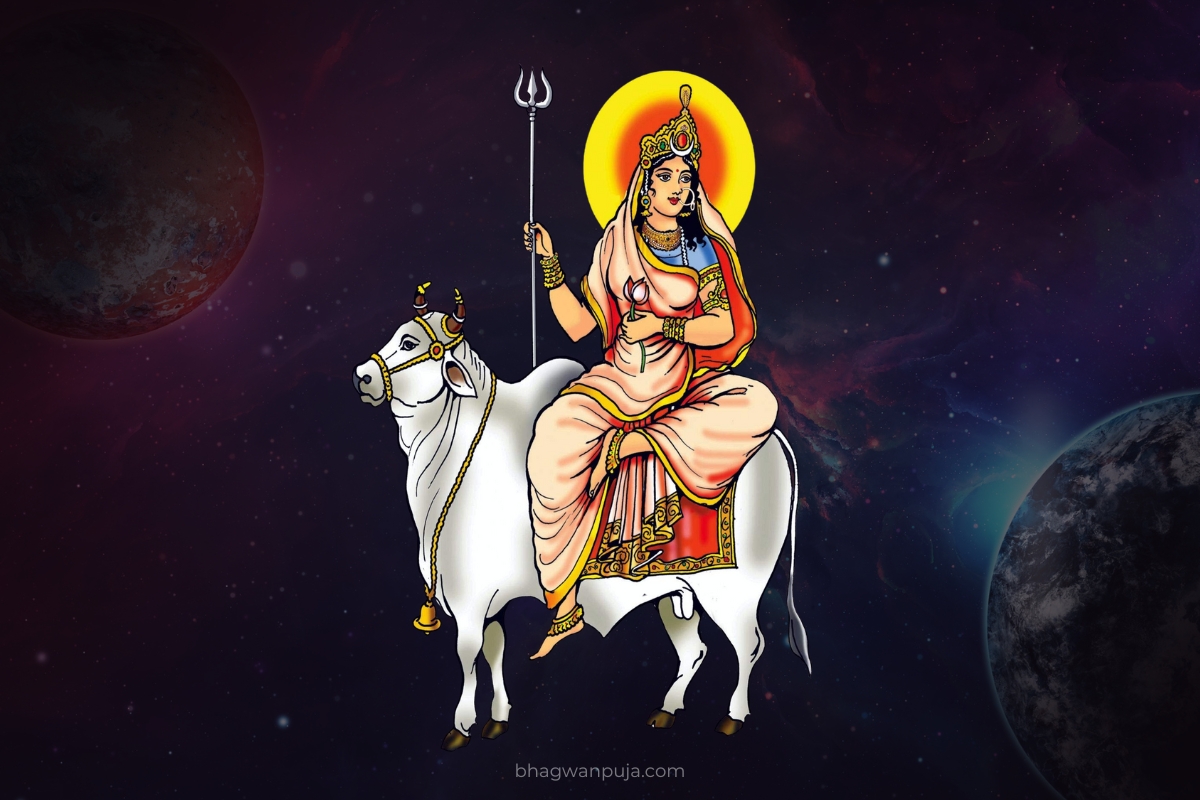
Navratri, also known as Shardiya Navratri, is a highly auspicious festival in Hindu culture that commences in the month of Ashwin, as per the Hindu calendar. Celebrated over nine days, this festival holds immense religious and cultural significance. During these nine days, devotees pay homage to the nine forms of Goddess Durga, with each day dedicated to a specific form. The first day of Navratri is marked by the worship of Maa Shailputri.
The name “Shailputri” is derived from the amalgamation of two Sanskrit words – ‘Shail’ meaning mountain and ‘Putri’ meaning daughter. Therefore, Maa Shailputri translates to “Daughter of the Mountains.” She is revered on the inaugural day of Navratri.
Goddess Shailputri Navratri Date and Puja in 2024
Navratri in 2024 commenced on the 3rd of October. The first day of Navratri is dedicated to the worship of Maa Shailputri and is marked by the observance of the ‘Ghatasthapana’ ritual. Maa Shailputri is considered the embodiment of Mother Nature, hence her worship on this day.
The ‘Ghatasthapana’ ritual involves the placement of a clay pot with a wide mouth, into which seven types of soil, known as ‘Saptmritika,’ are put. Seven types of food grains and barley seeds are then sown into this pot. Water is sprinkled on the sown seeds until the soil becomes moist. After this, the pot is set aside.
A ‘kalash’ is filled with holy Ganga water, and some ‘akshat’ is added to the water. Five types of coins and ‘druva’ are placed inside the kalash. Then, five mango leaves are positioned upside down in a circular arrangement to cover the brim of the kalash, and a coconut is placed on top of it.
The choice to either cover the coconut with red cloth or to tie a red ‘moli’ around it is at the discretion of the worshipper. In the middle of the clay pot, where the grains have been sown, Goddess Durga is invoked in the form of Shailputri by chanting the ‘Shailputri mantra,’ ‘Om Devi Shailputryai Swaha,’ 108 times. Subsequently, the Durga aarti, along with Maa Shailputri’s aarti, is recited. The ‘Panchopchara Pooja,’ involving the worship with five items, is then performed. This begins with lighting a ghee lamp, followed by ‘doop bati,’ offering of flowers, aromatic fumes to the kalash, and ‘Naivedheya’ to the kalash.
Ghatasthapana Muhurat: Morning: 06:30 AM to 07:31 AM, Abhijit Muhurat: 12:03 PM to 12:51 PM
Mythology of Maa Shailputri on Navratri
In Hindu mythology, it is believed that Maa Shailputri was born after Goddess Sati self-immolated herself, subsequently being reborn as Parvati, the daughter of the Himalayas. She is the foremost among the nine forms of Goddess Durga, often depicted riding a bull. In her hands, she holds a trident and a lotus flower. She is also known as Hemavati. According to Drik Panchang, it is believed that Goddess Shailputri governs the moon, bestowing all fortunes.
Significance of Goddess Shailputri Puja
Maa Shailputri is revered as the first Goddess in Navadurga, and her worship is believed to bestow strong willpower. She is also known as the Goddess of the Muladhara Chakra. Her grace fills the devotee’s entire being with energy, instilling the determination to accomplish any task. Grey is the color of significance on this day, symbolizing the destruction of evil.
History of Mata Shailputri
According to Hindu tradition, Goddess Sati was reborn as Shailputri, the daughter of King Himalaya, after her self-immolation. The name “Shailputri” encapsulates “Shail,” meaning mountain, and “Putri,” meaning daughter of mountains. Worshipping Mata Shailputri on the first day of Navratri is believed to bring good fortune into one’s life.
 The story behind worshipping Mata Shailputri on the first day of Navratri is as follows: In the past, she was the daughter of King Daksha, named Sati. One day, when King Daksha was absent, his wife Prashuti married their daughter Sati to Lord Shiva. This marriage was not anticipated or accepted by King Daksha. He was infuriated and humiliated, severing all ties with his daughter. Over time, Daksha’s anger intensified. He organized a grand Yagna (ritual sacrifice) and invited all gods and goddesses except Lord Shiva. Despite Daksha’s disapproval, Sati desired to attend the Yagna, hoping for a family reunion. So, she left the mountains joyfully with Lord Shiva. However, Lord Shiva initially refused to attend but later relented and joined the event. Upon seeing Lord Shiva and Sati at the Yagna, Daksha publicly insulted Lord Shiva. Witnessing the humiliation of her husband, Sati immolated herself in the Yagna’s fire. She was subsequently reborn as the daughter of Himavat (the Himalayas) and was named Himavati, also known as Parvati. She eventually married Lord Shiva and became known as Maa Shailputri, the daughter of mountains.
Conclusion
Worshipping Maa Shailputri on the first day of Navratri is believed to enhance an individual’s wealth, and possessions, and instill strong willpower, enabling the successful completion of any endeavor. This day holds the color grey, representing the destruction of evil.
This article highlights the significance of Navratri’s initial day, dedicated to the worship of Maa Shailputri, in a professional and informative manner.
