

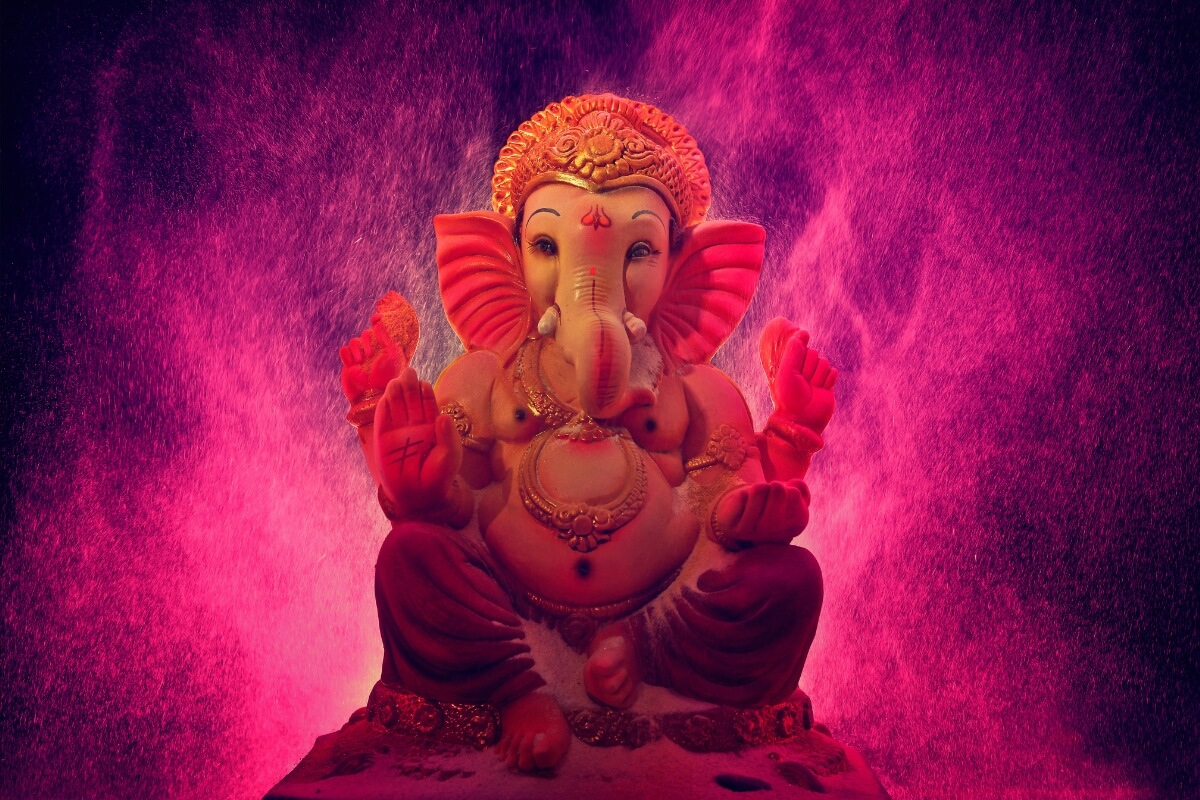
Om Shri Ganeshay Namah! Lord Ganesha is the Hindu God (Deity) he is believed to be the Lord of new beginnings that why, he is worshipped at the start of all Hindu religious ceremonies. He is the Lord of letters and is associated with intellectualism. Hence, he is the patron of authors, bankers, scholars, and the like. He is also called ‘Vighnaharta’ i.e. The remover of obstacles.
Whereas, long-time research of holy Vedas and pious Bhagavad Gita and other scriptures provides evidence that the whole universe is created by Aadi Ganesha who is immortal. He is the destroyer of sins. (Yajurved Adhyay 8 Mantra 13) He is the remover of obstacles. He is the supreme Lord who is worthy to be worshipped. (Yajurved Adhyay 5 Mantra 32)
The question raised in the mind of every devotee related to Lord Ganesha is, who is Lord Ganesh? How was Lord Ganesha created? Who killed Lord Ganesha? And what is the right way to worship him? How many names of Lord Ganesha?
Let us proceed to get an answer based on the following questions
Who is Lord Ganesha?
Lord Ganesha (also Ganesa or Ganapati) is one of the most important gods in Hinduism. He is easily recognized with his elephant head and human body, representing the soul (atman) and the physical (maya). Ganesha is the patron of writers, travelers, students, and commerce, and he removes obstacles blocking new projects. The deity is fond of sweets, to the slight detriment of his figure.
Ganesha is also worshipped as a principal deity in both Jainism and Buddhism. For the Ganapatya Hindu sect, Ganesha is the most important deity.
Birth of Lord Ganesha & Meanings of Ganesha
Once a day Goddess Parvati was at home on Kailash preparing for a bath. As she didn’t want to be disturbed, she told Nandi that, to guard the door and let no one pass. Nandi faithfully took his post, intending to carry out Parvati’s wishes. But, when Shiva came home and naturally wanted to come inside, Nandi had to let him pass, being loyal first to Shiva. Parvati was angry at this slight, but even more than this, at the fact that she had no one as loyal to Herself as Nandi was to Shiva. So, taking the turmeric paste (for bathing) from her body and breathing life into it, she created Ganesha, declaring him to be her loyal son.
In next time Parvati wished to bathe, she posted Ganesha on guard duty at the door. In due course, Shiva came home, only to find this strange boy telling him he couldn’t enter his own house! Furious, Shiva ordered his army to destroy the boy, but they all failed! Such power did Ganesha possess, being the son of Devi Herself!
This behavior surprised Shiva after seeing that this was no ordinary boy, the usually peaceful Shiva decided he would have to fight him, and in his divine fury severed Ganesha’s head, killing him instantly. When Parvati learned of this, she was so enraged and insulted that she decided to destroy the entire Creation! Lord Brahma, being the Creator, naturally had his issues with this, and pleaded that she reconsider her drastic plan. She said she would, but only if two conditions were met: one, that Ganesha be brought back to life, and two, that he be forever worshipped before all the other gods.
After that Shiva, having cooled down by this time, and realizing his mistake, agreed to Parvati’s conditions. He sent Brahma out with orders to bring back the head of the first creature he crosses that is laying with its head facing North. Brahma soon returned with the head of a strong elephant, which Shiva placed onto Ganesha’s body. Breathing new life into him, he declared Ganesha to be his son as well and gave him the status of being foremost among the gods, and leader of all the ganas (classes of beings), Ganapati.
The name of Ganesha means ‘Lord / Chief of the Ganas’ (an army of divine beings) and also the ‘Lord of the people’.
Other Names of Lord Ganesha
Most commonly Ganesha is greeted by the names like ‘Ganapati, Gajavaktra (one whose mouth is like an elephant), Haridra (one with golden skin), Gajanan, Dwimukha, Vighnaharta, Vighnakarta, Vinayaka, Mahaganapati, Heramba, Siddhaye, Vakpati, Shivapriya, Siddhivinayaka, Agraganyaya, Agrapujyaya, Sarvaya, Ganga Sutaya, Shri Vighneshwaraya.
He is also called ‘Lambodara’ and ‘Mahodara’ which is descriptive of his potbelly. He has a single whole tusk and the other one is broken which gives him the name ‘Ekadanta’ and so on.
Mantras of Lord Ganesha
Here are some powerful mantras dedicated to Lord Ganesha, known for removing obstacles and bringing success:
- Om Gan Ganapataye Namah
- This is one of the most popular mantras for invoking Lord Ganesha’s blessings.
- Vakratunda Mahakaya
- Chanting this mantra helps in overcoming difficulties and challenges.
- Ganesha Gayatri Mantra
- “Om Ekadantaya Vidmahe, Vakratundaya Dhimahi, Tanno Danti Prachodayat”
- Om Ekadantaya Vidmahe
- This mantra honors Lord Ganesha’s unique one-tusked form.
Each of these mantras has its significance and is chanted to seek various blessings, such as wisdom, prosperity, and protection from obstacles.
Attributes of Lord Ganesha
Lord Ganesha, the revered Hindu deity, embodies various attributes that symbolize wisdom, protection, and prosperity:
- Elephant Head: Represents wisdom, intelligence, and memory.
- Large Ears: Signifies the importance of listening and learning.
- Trunk: Symbolizes adaptability and efficiency.
- Single Tusk: Represents retaining the good and discarding the bad.
- Four Arms: Depicts strength and divinity, holding different objects like a modak (sweet), an axe, a lotus, and a noose.
- Mouse (Vahana): Demonstrates humility and the ability to conquer desires.
These attributes make Lord Ganesha the remover of obstacles and the harbinger of new beginnings.
What are the vehicles of Lord Ganesha?
Mouse is the vehicle of Lord Ganesha which is symbolic to eliminate inner darkness which means to curb the desire.
Whom did he get married?
He is married and has two wives named Ridhi and Siddhi. Ridhi means prosperity and Siddhi means spiritual power. He had children his names were Subh and Laabh, in which Subh means auspiciousness and Laabh means profit, this is why these words are often written along with his idol.
Who killed Ganesha?
When Lord Shiv Ji returned after completing austerity from the Himalayas and tried to enter inside the palace of Parvati Ganesh Ji was adamant in keeping the words of his mother. On facing resistance from Ganesha, out of ignorance and rage, Shiva beheaded Ganesha with his trident and entered into the house.
Who is Aadi Ganesha?
All the devotees must make pious Vedas and holy Shrimad Bhagawad Gita the base of their worship. Puranas are not the words of God. They are the personal experiences of some deity/saint/sage. By reading Puranas we can understand the birth and death cycle but will remain devoid of getting true spiritual benefits from God. Pious Vedas and Gita Ji are the words of God.
This is all according to the holy scriptures taking initiation from the enlightened saint i.e. Param Akshar Brahm will help souls attain salvation.
He plays the divine spectacle of an enlightened saint, imparts true knowledge to the devotees, provides true mantras with which salvation is attained and seekers go to that eternal world where they never come back to this deceased world of Brahm-Kaal. Only Aadi Ganesha is worthy to be worshipped.
